
Article on NanoQAM in Le Devoir
A new player in nanotechnology
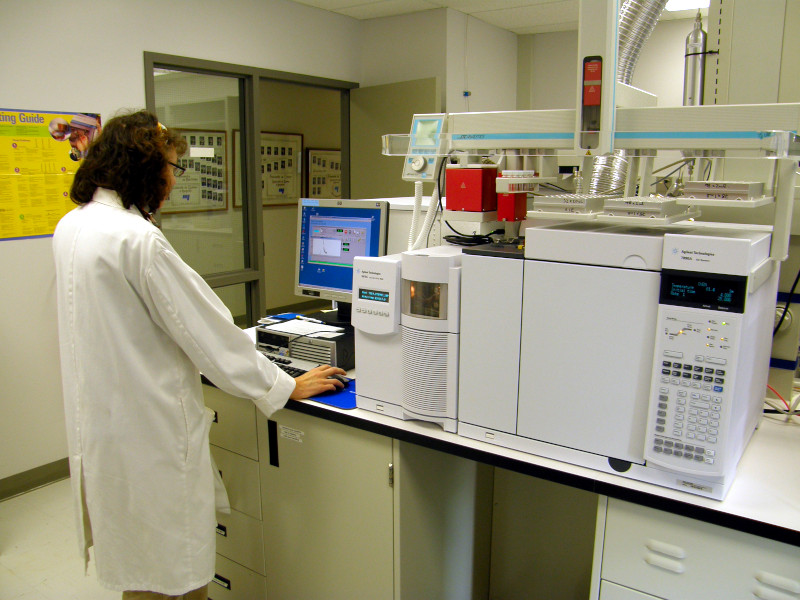
Generally recognized for its training programs and research in the social sciences and communication, UQAM also wishes to make its place in the world of pure and applied sciences. Founded less than two years ago, the Center for Research on Nanomaterials and Energy, NanoQAM, is a good illustration of this reality. Its four laboratories, worth almost $ 8 million in equipment, host eleven professors, seven of whom have been hired in the past five years. A growing field, enormous challenges to be met.
Many hopes are based on research in the field of nanomaterials, be it in health, in the energy sector and many more. By deciding to give importance to this research sector, UQAM is well aware that it is faced with great Quebec players already well established in the field, whether Polytechnique, UdeM, the INRS or others.
“It is certain that we are not the only ones working on nanomaterials; however, each great player has, as a rule, a specificity. At UQAM, for example, we work a lot on organic materials, which are generally more flexible and lighter than inorganic materials, ”says Jérôme Claverie, director of NanoQAM.
Organic nanomaterials can have a variety of applications. The classic case: the controlled release of drugs into the body. “Generally, for cancer, the nanoparticle brings the drug to the cancer cell without attacking the healthy cells around. Research in this area is very advanced, but other major players, such as UdeM, are also working on it, “said Mr. Claverie, also a chemist and researcher.
Other kinds of research are carried out at NanoQAM, such as those aimed at developing antimicrobial nanomaterials. “We are also working on light-emitting diodes made from organic matter, therefore more flexible, which could have interesting applications. Among other things, we could possibly make foldable television screens thanks to that! ”Exclaims the professor.
Social mission for high knowledge!
And what happens in this institution is found elsewhere, even at Bishop, the originally English-speaking university of Sherbrooke, which however has only undergraduate programs to offer its 2,000 students. The hiring policy thus favors anyone who declares himself a professor-researcher and whose authority is sufficient to receive financial support from a granting agency, whether the latter is public or private.
And research even adds to the panoply of programs that a university offers. There is no medicine or engineering at UQAM, never mind! NanoQAM arrives and this research center on nanomaterials and energy already has four laboratories, uses equipment whose value is close to eight million dollars, shelters eleven professors, seven of whom have been hired recently. And research is carried out on these nanomaterials which are useful in the fight against cancer or necessary in the search for new sources of energy.
In fact, the university and the specialized school appear as “useful” places. If certain professors had expressed their doubts when the ETS was created, the École de technologie supérieure, to the point that UQAM had not seen the point of welcoming this institution into its fold when it was in difficulty a few years after its creation, it is certain that more than one rector subsequently regretted such a decision. The ETS, which declares itself a partner of the industrial world, has become a model in the establishment of a project which links university and research. In Toronto, the Ryerson Polytechnical Institute has the same reputation.
Source and Article : www.ledevoir.com